
Epoxy vs. Polyaspartic: Which Coating System Delivers Better Results for Contractors?
Contractors today are under more pressure than ever to deliver fast, durable, and high-quality concrete coating results. Choosing between epoxy and polyaspartic coatings isn’t just about preference it directly impacts your efficiency, reputation, and profitability.
While epoxy has been the industry standard for years, polyaspartic coatings are quickly becoming the preferred choice for contractors who want better performance and faster turnaround times.
Understanding how these two systems compare will help you choose the right solution for each project and stay competitive in a demanding market.
KEY DIFFERENCES BETWEEN EPOXY AND POLYASPARTIC COATINGS
Both epoxy and polyaspartic coatings are designed to protect and enhance concrete surfaces. However, their performance in real jobsite conditions is very different.
Polyaspartic coatings offer:
- Fast cure times (same-day return to service)
- Excellent UV stability (no yellowing)
- High flexibility and impact resistance
- Wide application temperature range
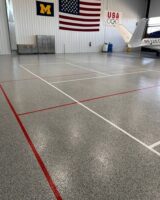
Polyaspartic Floor Coating
Epoxy coatings offer:
- Lower upfront material cost
- Strong adhesion in controlled environments
- Good performance in low-traffic areas
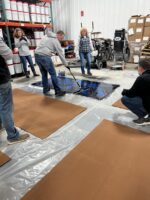
Epoxy Training
Quick Comparison:
- Curing Time: Polyaspartic (under 24 hours) vs Epoxy (2–3 days)
- Durability: Polyaspartic (high) vs Epoxy (moderate)
- UV Resistance: Polyaspartic (excellent) vs Epoxy (moderate)
- Application Window: Polyaspartic (flexible) vs Epoxy (temperature-sensitive)
- Cost: Polyaspartic (higher upfront) vs Epoxy (lower upfront)
1. DURABILITY: WHY IT MATTERS ON REAL JOBSITES
As a contractor, your reputation depends on how well your floors hold up over time.
Polyaspartic coatings are built for high-traffic and high-impact environments. They resist abrasion, chemicals, and heavy use without cracking or peeling. Their flexibility allows them to handle movement and stress better than epoxy.
Epoxy, on the other hand, can become brittle over time. In demanding environments, this can lead to chipping, peeling, and costly callbacks.
If you’re working on garages, warehouses, or industrial floors, durability isn’t optional—polyaspartic gives you a clear advantage.
2. INSTALLATION SPEED: WIN MORE JOBS IN LESS TIME
Time is one of the biggest constraints for contractors.
Epoxy systems can take several days to fully cure, delaying project completion and limiting how many jobs you can take on.
Polyaspartic coatings cure rapidly:
- Ready for light traffic in just a few hours
- Full return to service within 24 hours
What this means for you:
- Complete more jobs per week
- Reduce client downtime
- Increase overall revenue
Polyaspartic also performs well in extreme temperatures, allowing you to work year-round without seasonal slowdowns.
3. COST VS. VALUE: THINK BEYOND MATERIAL PRICE
Many contractors default to epoxy because of the lower upfront cost but that can be misleading.
Epoxy often comes with:
- Longer installation time
- Higher labor costs
- More frequent maintenance and repairs
Polyaspartic may cost more initially, but it delivers:
- Longer lifespan
- Fewer callbacks
- Faster project turnaround
For contractors focused on long-term value and client satisfaction, polyaspartic is often the more profitable choice.
4. BEST APPLICATIONS FOR EACH COATING
Choosing the right coating depends on the job.
Use Epoxy When:
- Budget is the primary concern
- The space has low traffic (basements, utility rooms)
- Cure time is not an issue
Use Polyaspartic When:
- You need fast turnaround
- The area sees heavy traffic or machinery
- UV exposure is a concern (garages, outdoor areas)
- Clients expect long-term performance with minimal maintenance
For most commercial and high-demand residential projects, polyaspartic is the better fit.
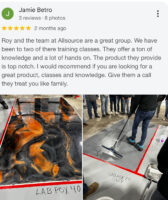
Client Review
WHY CONTRACTORS ARE SHIFTING TO POLYASPARTIC
More contractors are moving toward polyaspartic systems because they:
- Improve efficiency
- Deliver consistent results
- Reduce project delays
- Increase customer satisfaction
With the right materials and proper training, contractors can scale faster and stand out in a competitive market.
FAQS FOR CONTRACTORS
How long do polyaspartic coatings last?
They can last 10–20 years or more with proper installation and maintenance, even in high-traffic environments.
How fast can I complete a job?
Most polyaspartic systems allow for same-day or next-day completion, depending on conditions.
Can I apply polyaspartic in cold weather?
Yes, it can be applied in a wide range of temperatures, making it ideal for year-round work.
WHICH SHOULD YOU CHOOSE?
Epoxy still has its place for low-budget, low-demand projects. But for contractors focused on performance, efficiency, and long-term value, polyaspartic coatings are the smarter choice.
If you want to complete more jobs, reduce callbacks, and deliver high-quality results your clients can trust, it’s time to seriously consider making the switch.
Looking to upgrade your coating system and improve job efficiency?
Call us today at 833-663-4255 to learn how the right materials and training can help you deliver faster, stronger, and more profitable flooring solutions.

With over two decades in the construction industry, Roy Magnuson has cultivated a deep expertise in concrete repair and coating applications across various environments. His early passion for decorative concrete led him to co-found Allsource Supply Inc. in 2013, a family-owned business based in Oshkosh, Wisconsin. Under his leadership, the company has become a trusted provider of high-quality concrete coatings, equipment, and contractor supplies, serving professionals nationwide. Roy's commitment to customer-centric service ensures that clients receive not only top-tier products but also the expert advice needed to get the job done right.